
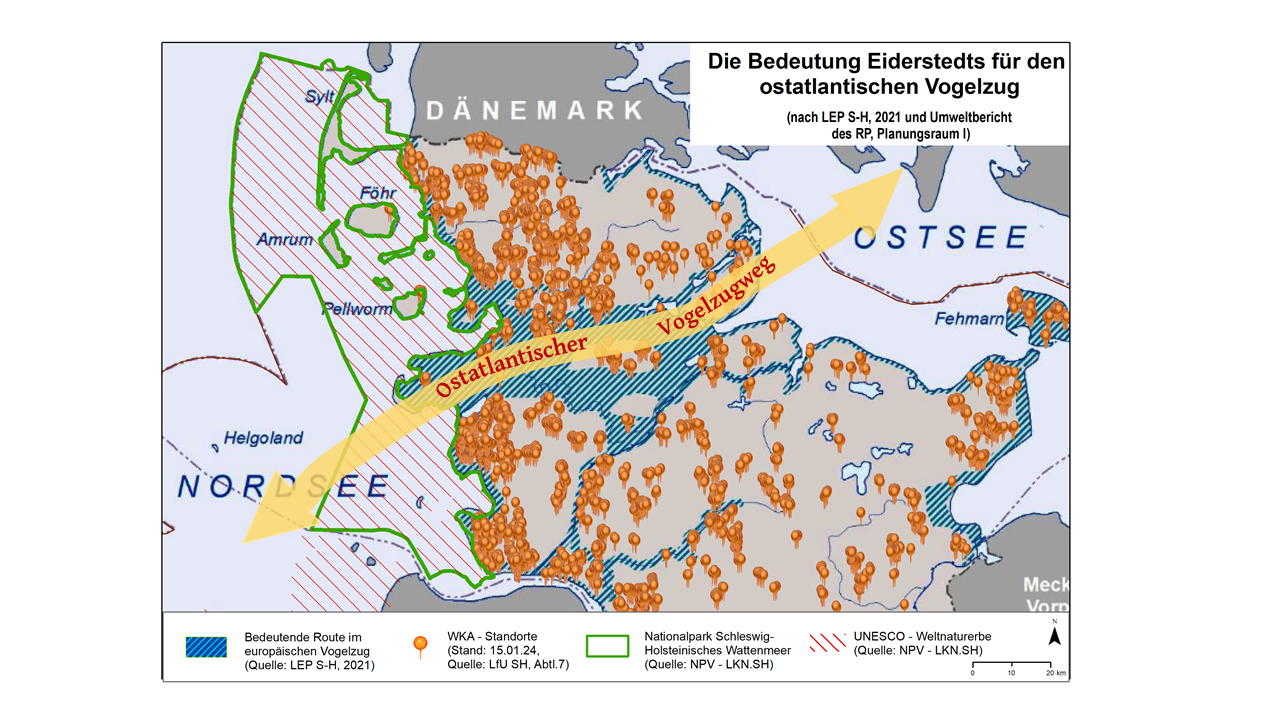
The recently adopted regional development plan for wind energy in Schleswig-Holstein marks a significant step for both nature conservation and the energy transition, and highlights the growing influence of the East Atlantic Flyway concept in environmental decision-making.
The Eiderstedt peninsula, one of the most critical bottlenecks along the East Atlantic Flyway between the Elbe estuary and Denmark, has long been recognized as a key passage for migratory birds. At the same time, it is an exceptionally important breeding area for meadow birds, making it one of the most sensitive and valuable cultural landscapes in northern Europe.
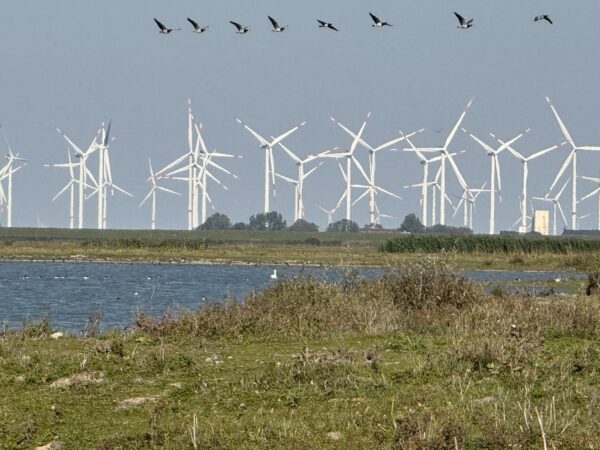
In early 2024, when new plans emerged that would have opened Eiderstedt to large-scale wind energy development, serious concerns were raised about the potential closure of this last remaining open corridor. At that point, Bernd Scherer, former director of the Schleswig-Holstein Wadden Sea National Park, reached out to the different authors of the East Atlantic Flyway book, asking them to support conservation efforts.
This initiative helped bring the international importance of the flyway into the political debate. The local action group in Eiderstedt adopted both the book and the term “East Atlantic Flyway” as central arguments in their campaign, successfully framing the peninsula not as an isolated landscape, but as a vital link in a global ecological network.
Following two years of intensive engagement by local communities, scientists, NGOs, and civil society organizations, the Schleswig-Holstein Parliament approved the updated regional plan on March 18. The new regulation now legally excludes most of Eiderstedt from further wind turbine development, recognising the need to preserve this unique migratory corridor and breeding habitat.
This outcome demonstrates that the expansion of renewable energy and the protection of biodiversity need not be mutually exclusive. Instead, it shows that informed, science-based advocacy, combined with strong local commitment, can lead to balanced and forward-looking solutions.
However, the decision is not without its contradictions. A designated expansion area near Oldenswort remains a concern, as it could further narrow the migratory route and impact important breeding grounds. Despite these unresolved issues, the overall result represents a major success for conservation.
For Eiderstedt, this is a moment of real progress, one that also illustrates how concepts like the East Atlantic Flyway can shape not only scientific understanding but also concrete political outcomes.