
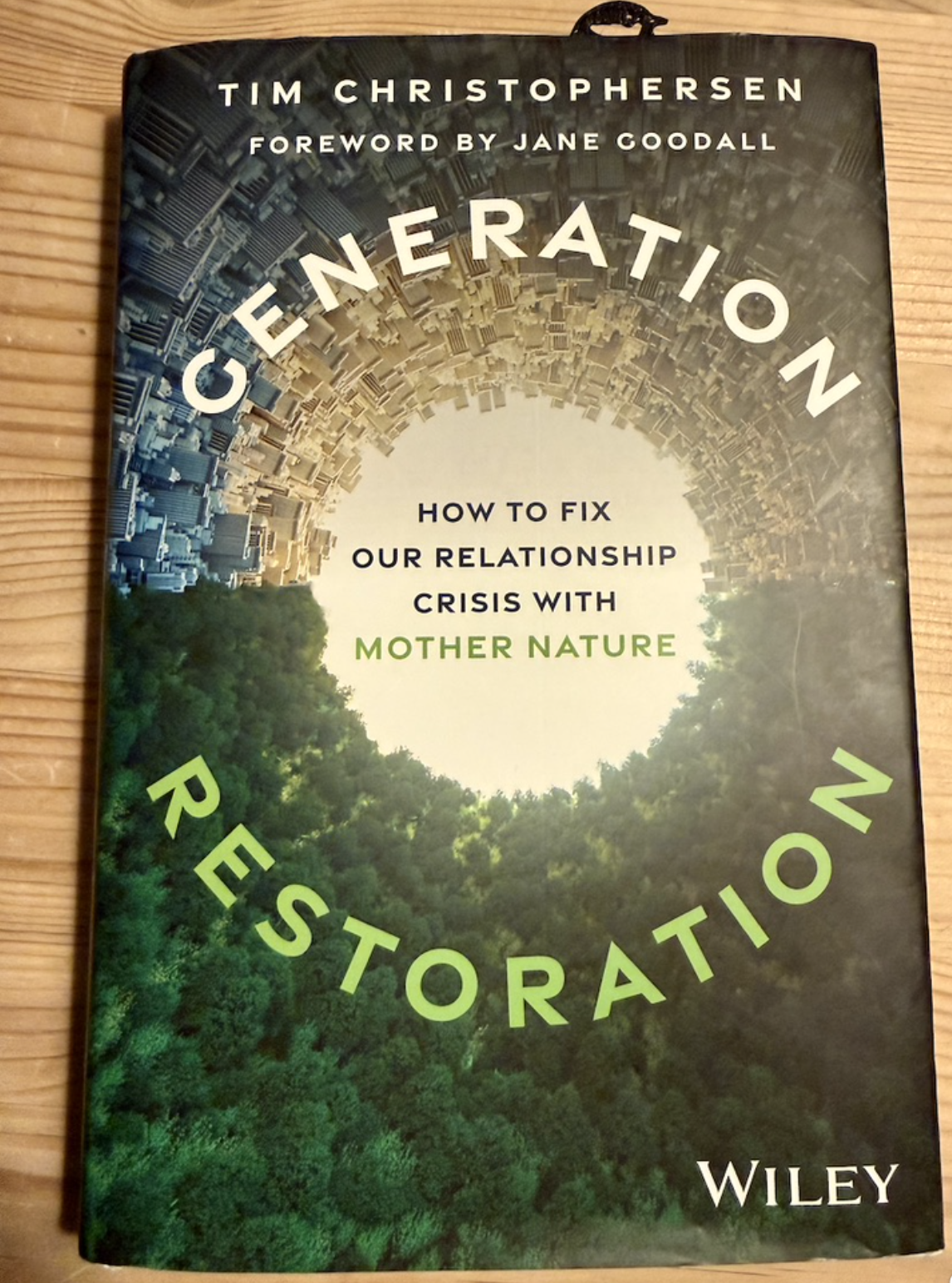
Book Review: Generation Restoration – How to Fix Our Relationship with Mother Nature by Tim Christophersen Foreword by Jane Goodall
When I picked up Generation Restoration, I did so not only as a reader concerned about the state of our planet, but also as a former colleague of Tim Christophersen. Many years ago, Tim completed his civil service at the Schutzstation Wattenmeer on the island of Sylt—some years after I had done the same. We then went our separate ways, but our paths kept crossing when it came to nature conservation issues and organisations.: Tim went on to work for the United Nations Environment Programme (UNEP) in Nairobi, where he played a key role in advancing global ecosystem restoration, and today he continues to shape international environmental policy, when he is not at home on his ecological farm in Denmark. That breadth of experience—grassroots conservation, global diplomacy, and practical land stewardship—deeply informs this book.

Published by Wiley and introduced with a foreword by Jane Goodall, Generation Restoration is far more than a technical manual on ecological repair. Its subtitle, “How to Fix Our Relationship with Mother Nature,” signals its true ambition: to redefine how we see ourselves in the web of life.
Christophersen does not shy away from confronting humanity’s destructive footprint. He describes with clarity how deforestation, industrial agriculture, climate change, and biodiversity loss have eroded ecosystems across the globe. Yet the tone of the book is not accusatory—it is resolutely hopeful. His central message is that restoration is not only possible, it is already happening. By highlighting successful initiatives from around the world, he demonstrates that nature possesses remarkable regenerative power—if we give it the chance.
At the philosophical core of the book lies a crucial reframing: humans are not separate from nature. The very term “environment,” he argues, is misleading because it suggests something external to us. Conservation alone—protecting isolated areas from human interference—is insufficient if we continue to degrade the remaining majority of the planet. Even the internationally celebrated 30×30 target (protecting 30% of Earth’s land and sea by 2030) will fall short if the other 70% is subjected to unsustainable exploitation. We must recognize that we exist in constant exchange with the natural systems that sustain us.
Christophersen’s perspective is holistic. Conservation, restoration, and sustainable use are not competing strategies but complementary pillars. He stresses the importance of landscape-scale approaches—thinking beyond isolated protected areas toward integrated systems that combine ecological health with human livelihoods.
One compelling example he presents is Acción Andina, a transnational movement restoring native forests along the Andes. Supported by thousands of local people across multiple countries, the initiative not only reforests degraded mountain slopes but also secures downstream water supplies. It embodies Christophersen’s conviction that restoration must integrate social dimensions: ecological repair and community empowerment go hand in hand.
The book also explores models such as Satoyama landscapes in Japan, where traditional land use practices maintain harmony between human production and biodiversity. Similarly, Europe’s Natura 2000 network—the world’s largest coordinated system of protected areas—illustrates what collective political will can achieve. Yet Christophersen reminds us that protection alone is insufficient without active restoration and sustainable management.
An especially forward-looking aspect of Generation Restoration concerns finance. While Christophersen acknowledges that nature’s value cannot be reduced to monetary terms, he observes a growing trend: major investment funds are increasingly directing capital toward nature-based solutions. Nature investments now move in the trillion-dollar range. However, there is a shortage of large, “bankable” restoration projects. The future, he argues, lies in building and scaling a global restoration economy—one that integrates social benefits and aligns private interests with ecological recovery.
The climate crisis, in his analysis, is inseparable from our behavioral crisis toward nature. Reducing emissions alone will not suffice. Investments in reforestation, agroforestry, peatland restoration, and other nature-based solutions can simultaneously sequester carbon, restore biodiversity, and strengthen local resilience. High-quality carbon credits tied to genuine ecosystem recovery may become a powerful tool—if integrity and ecological depth are maintained.
Christophersen invites us to see nature as critical infrastructure—just as essential as roads, airports, or power lines. Without functioning forests, wetlands, soils, and oceans, our societies cannot endure. This conceptual shift is profound: restoration becomes not charity for the planet, but an investment in our collective survival.
The book is also enriched by respect for Indigenous knowledge systems. Indigenous-managed territories often show higher biodiversity and more sustainable resource use. From these communities, Christophersen suggests, we can learn humility, reciprocity, and gratitude toward “Mother Nature.”
At times, the book ventures deep into biological and philosophical reflections. It is not always an easy read; the scope is vast, and the arguments are layered. One must pause, reflect, and sometimes reread to fully grasp the interconnected thinking. But this intellectual depth is precisely what gives the book its weight. It challenges readers not only to understand restoration intellectually but to reimagine it at planetary scale.
Perhaps one of the most powerful observations Christophersen makes is that we lack a mental image of what large-scale ecosystem restoration could look like. We are accustomed to envisioning destruction, not recovery. Generation Restoration provides that missing imagination. It paints a picture of landscapes reborn, communities engaged, and economies aligned with ecological regeneration.
The epilogue emphasizes freedom of choice. We are not doomed to continue on a destructive path. Optimism, Christophersen insists, is not naïveté—it is mandatory. The book concludes with a practical list of actions, inviting each reader to contribute according to their passion and capacity.
Ultimately, Generation Restoration is comprehensive, at times deeply philosophical, and grounded in extraordinary professional experience. It is not a simple handbook, but it is an inspiring one. It reminds us that conservation and restoration are not abstract policy goals—they are shared human responsibilities.
I myself will continue to focus my interest and activities on nature conservation and the 30 x 30 target, at least until 2030. But Tim’s book has inspired me – even if I didn’t understand everything clearly – to broaden my horizons towards restoration, i.e. to become part of the restoration generation. And perhaps we can allow ourselves to be positively surprised and contribute in small ways to making Tim’s visions a reality by 2052.
Peter Prokosch