
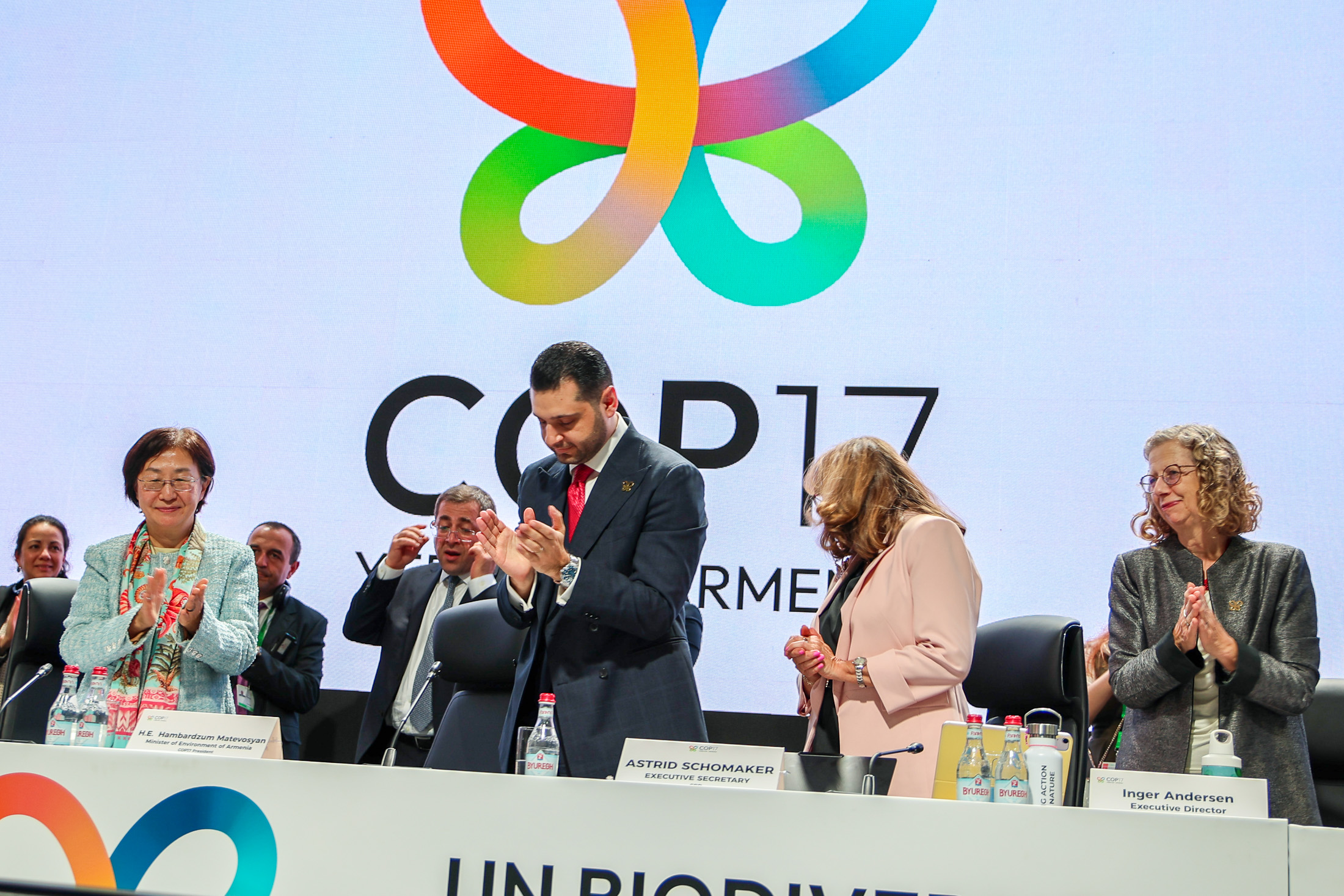
The first global review of the Kunming–Montreal Global Biodiversity Framework confirms that the world is still falling short of its 2030 nature targets. The new Yerevan Pathway offers an opportunity to accelerate action, but the gap between commitments and effective conservation remains substantial. Norway’s marine protection record illustrates the challenge.
COP17: A reality check for the global biodiversity agenda
The 17th Conference of the Parties to the Convention on Biological Diversity (CBD COP17), which concluded in Yerevan, Armenia, on 31 October 2026, marked an important milestone. For the first time, governments conducted a global review of collective progress towards implementing the Kunming–Montreal Global Biodiversity Framework (GBF), adopted in December 2022.
The framework established an ambitious set of 23 targets for 2030, including the commitment to conserve at least 30% of the world’s land and oceans. Known as 30×30, this has become one of the most prominent global commitments to halt and reverse biodiversity loss.
The review at COP17 delivered an uncomfortable conclusion: the world is not on track to meet its 2030 targets. Fewer than half of the national targets assessed were considered on track, and substantial gaps remain in implementation, financing and monitoring.
Governments adopted the Yerevan Pathway, intended to accelerate implementation of the framework. They also agreed on measures addressing biodiversity monitoring, harmful incentives and the resources needed to deliver the global targets.
These are important steps. Yet the central challenge remains unresolved: how can governments turn international commitments into measurable improvements for nature within the four years remaining until 2030?
The conservation community welcomed the progress while warning that the outcome fell short of what is needed. The Wildlife Conservation Society stressed that current ambition remains insufficient, while the International Union for Conservation of Nature (IUCN) called for stronger implementation, adequate financing and more effective action on the ground.
1. The global 30×30 target: What has been achieved?
The 30×30 commitment represents a major shift in international conservation policy. It recognises that isolated protected areas cannot safeguard biodiversity if they cover too little of the planet, fail to represent different ecosystems or allow destructive activities to continue unchecked.
Progress is real, but incomplete.
Governments have expanded protected areas on land and at sea, developed national biodiversity strategies and begun identifying additional areas that may qualify as conservation measures. Some countries have established large marine protected areas, and the international recognition of other effective area-based conservation measures (OECMs) offers another route towards the target.
Nevertheless, the global picture remains far from satisfactory.
Marine protection, in particular, lags behind the ambition of 30×30. Furthermore, the percentage of an ocean declared protected does not necessarily tell us whether its ecosystems are actually safeguarded.
An area may carry the designation of a marine protected area while still allowing intensive fishing, damaging seabed activities or other pressures incompatible with its conservation objectives.
The real test of 30×30 is therefore not simply how much area is designated, but how much biodiversity is effectively conserved.
Target 3 of the Kunming–Montreal Framework explicitly requires areas to be conserved and effectively managed, with representative coverage of important ecosystems and connectivity between them. It also recognises Indigenous and traditional territories and OECMs as potential contributors.
This means that governments must demonstrate not only geographical coverage but also appropriate management, long-term conservation outcomes and equitable governance.
2. Is there still a realistic chance of achieving 30×30 by 2030?
There are reasons for optimism, but they must not be confused with evidence that the target is already within reach.
Reasons for hope
First, the international commitment is established. The 30×30 target is no longer merely an aspiration promoted by conservation organisations. It is part of an agreed global biodiversity framework, endorsed by governments and supported by a growing international conservation movement.
Second, the tools for implementation are improving. Countries can draw on established protected-area legislation, spatial planning, ecosystem assessments and the recognition of OECMs. The latter can help identify places where existing, geographically defined and enduring management measures deliver demonstrable conservation benefits.
Third, the first global review provides a clearer picture of the implementation gap. The Yerevan Pathway offers a political framework for accelerating action before 2030. The COP17 outcomes also create opportunities to strengthen monitoring and mobilise resources.
Fourth, the remaining four years can still deliver substantial progress. Governments can expand existing protected areas, establish new ones, strengthen restrictions on damaging activities and improve management and enforcement.
Reasons for concern
The obstacles are considerable. Financing remains inadequate, national ambitions do not yet add up to the agreed global targets, and competing economic interests continue to constrain conservation.
The global review makes clear that the problem is not simply a lack of targets. It is the gap between political commitments and implementation.
There is also a danger that governments will focus on increasing the reported percentage of protected territory rather than establishing conservation measures that deliver real ecological benefits.
Our assessment: Achieving 30×30 remains possible only if governments substantially accelerate action. COP17 has strengthened the framework for implementation, but it has not demonstrated that the global target will be met.
The decisive indicators over the coming years will be new areas placed under effective protection, stronger restrictions on destructive activities, adequate financing and transparent reporting of actual conservation outcomes.
3. Norway and 30×30: A marine conservation gap
Norway has a strong international reputation for ocean management and marine research. It also has extensive marine areas, important fisheries and globally significant ecosystems. It has also been a leading promoter of the 30×30 target.
However, Norway’s progress towards effective protection of its marine biodiversity remains far behind what its international commitments require.
The Norwegian Government’s own reporting provides a useful starting point. Its 2026 Voluntary National Review reports that approximately 4.5% of Norwegian marine areas fall within protected areas, national parks and conservation zones. Other official figures refer to approximately 4.2% of marine areas under statutory protection, reflecting differences in the areas and categories included.
These figures are far below the 30% target.
The distinction between Norway’s mainland waters, its wider marine jurisdiction and the waters around Svalbard also matters. Svalbard has extensive marine protection, but its inclusion can substantially change Norway’s overall figures. For the purposes of assessing the challenge facing mainland Norway and its surrounding seas, Svalbard must be considered separately.
The Norwegian Government has recognised the need to identify additional areas for marine conservation. Yet the pace of establishing effective protection has been slow, partly because of competing interests.
The challenge is not simply to create more protected areas. It is to establish protection that covers representative marine ecosystems and adequately addresses the activities that threaten them.
4. The 13.3% claim: What does Norway’s marine protection actually mean?
The Norwegian Minister of Climate and Environment has cited a figure of 13.3% for the share of Norwegian seas that are protected.
This figure needs to be understood in context.
On 28 October 2026, the Norwegian Environment Agency announced that a cross-government working group had identified potential additional marine conservation measures covering approximately 9.3% of Norwegian marine areas, including the extended continental shelf.
These areas are proposed for recognition as Other Effective Area-Based Conservation Measures (OECMs). They are not all formally designated marine protected areas. Instead, they include geographically defined areas where existing regulations and management measures may deliver long-term biodiversity conservation.
Examples include restrictions on bottom trawling to protect vulnerable seabed habitats and other sectoral measures that may contribute to conserving marine ecosystems.
Combining approximately 4% of marine areas under formal protection with the proposed 9.3% contribution from OECMs produces a figure in the vicinity of the minister’s 13.3%.
This is a potentially important development. Recognising effective conservation measures outside formally designated protected areas is consistent with the Kunming–Montreal Framework.
However, three qualifications are essential.
First, proposed OECMs are not automatically equivalent to effective protection. Each area must meet the relevant international criteria, including clearly defined boundaries, appropriate governance and management, and demonstrable, sustained biodiversity conservation outcomes.
Second, the geographical denominator matters. The Norwegian Environment Agency’s 9.3% estimate includes the extended continental shelf. Percentages calculated using different definitions of Norway’s marine territory cannot simply be compared as though they measured the same area.
Third, the quality of protection matters. Restrictions that protect vulnerable habitats from destructive activities can make a genuine contribution. But not every sectoral regulation safeguards all the biodiversity values of an area, and not every protected area excludes activities that may undermine its conservation objectives.
The figure of 13.3% should therefore be understood as an indication of Norway’s potential contribution through a combination of existing protection and proposed additional conservation measures, rather than proof that 13.3% of its seas already enjoy effective biodiversity protection.
5. The scientific evidence: Most Norwegian marine protected areas provide weak protection
A scientific assessment published in 2026 provides an especially important perspective on the effectiveness of Norway’s marine protection.
Researchers assessed Norwegian marine protected areas and associated zones using the international MPA Guide framework. The assessment covered 814 protected areas and 53 additional zones, together encompassing approximately 88,966 km², or 4.4% of Norway’s marine waters.
The results are striking:
- 91% of the area within the assessed protected areas and zones was classified as either minimally protected or incompatible with conservation.
- Approximately 9.5% of the assessed protected area was classified as lightly protected.
- Fully protected areas accounted for only 0.1% of the assessed protected-area coverage.
- This fully protected area represented approximately 0.004% of Norway’s marine waters.
- No highly protected marine areas were identified in the assessment.
The difference between these percentages matters. The 91% figure refers to the area within the assessed protected areas and zones, not 91% of Norway’s entire marine territory.
Even the Norwegian national parks don’t meet the international (IUCN) criteria, but meet only the criteria for landscape protected areas. They hardly have any no-take-zones.
Nevertheless, the results reveal a serious problem: much of the area officially designated for marine protection does not have restrictions strong enough to guarantee effective conservation.
Fishing is a particularly important issue. Protected-area designations do not necessarily exclude activities that damage seabed habitats or undermine ecosystem recovery.
This evidence challenges any assumption that expanding the nominal area under protection will, by itself, deliver the biodiversity outcomes required by 30×30.
Norway must strengthen the quality of protection as well as increase its geographical coverage.
Sources: Horta e Costa et al. (2026), Data on marine protection levels in Norwegian MPAs: A national application of The MPA Guide, Institute of Marine Research, Norway.
6. Can Norway effectively protect 30% of its seas by 2030?
The newly identified OECM candidates offer a potential opportunity to accelerate Norway’s progress.
If the existing protected areas and the additional candidate areas are validated, recognised and managed appropriately, Norway could make a substantial advance towards the target without relying exclusively on the designation of new marine protected areas.
But the remaining gap is considerable.
Taking the minister’s 13.3% figure at face value, approximately 16.7 percentage points would still be needed to reach 30%. That is a major expansion in effective conservation within just four years.
Moreover, the calculation is meaningful only if the existing and proposed measures meet the relevant conservation criteria and use a consistent geographical denominator.
What would make the target achievable?
1. Establish genuinely protected marine areas.
Norway should accelerate the designation of marine protected areas that cover representative ecosystems, including important seabed habitats, coastal ecosystems and areas essential to marine species.
2. Restrict damaging activities.
Protection must be reflected in management regulations. In sensitive areas, bottom trawling and other activities that damage habitats or undermine conservation objectives should be prohibited or sufficiently restricted.
3. Recognise only qualifying OECMs.
The proposed OECMs should undergo transparent, scientifically credible assessment. They should count towards 30×30 only where the measures meet the international criteria and provide long-term, demonstrable conservation benefits.
4. Improve protection within existing areas.
Norway should review existing marine protected areas and strengthen their management where current regulations do not adequately protect biodiversity. This could improve ecological outcomes even before additional areas are designated.
5. Establish large enough no-take zones at least in national parks. Norway has a few marine national parks under its national definition. They could be developed to meet the IUCN criteria for a “real” national park. (See e.g. Raet National Park)
6. Make progress transparent.
The Government should publish clear, regularly updated figures distinguishing formally protected areas, proposed OECMs and areas that have been independently assessed as effectively conserved. The reporting should make clear which geographical areas are included and which activities remain permitted.
What are the reasons for optimism?
Norway has considerable scientific expertise, established marine management institutions and experience in regulating activities at sea. The new OECM assessment demonstrates that the Government is beginning to explore how existing measures might contribute to the international target.
This provides a basis for progress.
However, the critical question is whether Norway will use these instruments to secure meaningful biodiversity conservation, rather than primarily to improve its reported percentage.
The scientific assessment of existing protected areas shows why that distinction matters.
Our conclusion is that Norway can still make substantial progress towards 30×30 by 2030, but achieving 30% effective marine conservation will require a much stronger commitment to both expanding and strengthening protection. The proposed OECMs are a potentially valuable contribution, not a substitute for that commitment.
7. VISION 52: From protected areas on paper to effective ocean conservation
The outcome of CBD COP17 reinforces a central message of VISION 52: the global conservation challenge is no longer simply to establish targets. It is to implement them in ways that deliver measurable results for nature.
The 30×30 target is an opportunity to safeguard the ecological systems on which marine biodiversity, fisheries and coastal communities depend. But the target will lose much of its meaning if governments count areas as protected without ensuring that damaging activities are adequately controlled.
Norway has an opportunity to demonstrate international leadership by combining rigorous science, transparent reporting and effective marine conservation.
That means assessing proposed OECMs against international criteria, strengthening existing protected areas, protecting vulnerable habitats and ensuring that conservation measures deliver long-term benefits for biodiversity.
The same principles apply globally. Governments must move beyond counting protected square kilometres and demonstrate that their policies are helping nature recover.
Four years remain until 2030. The question is no longer whether the world has agreed to 30×30, but whether governments will now deliver it.