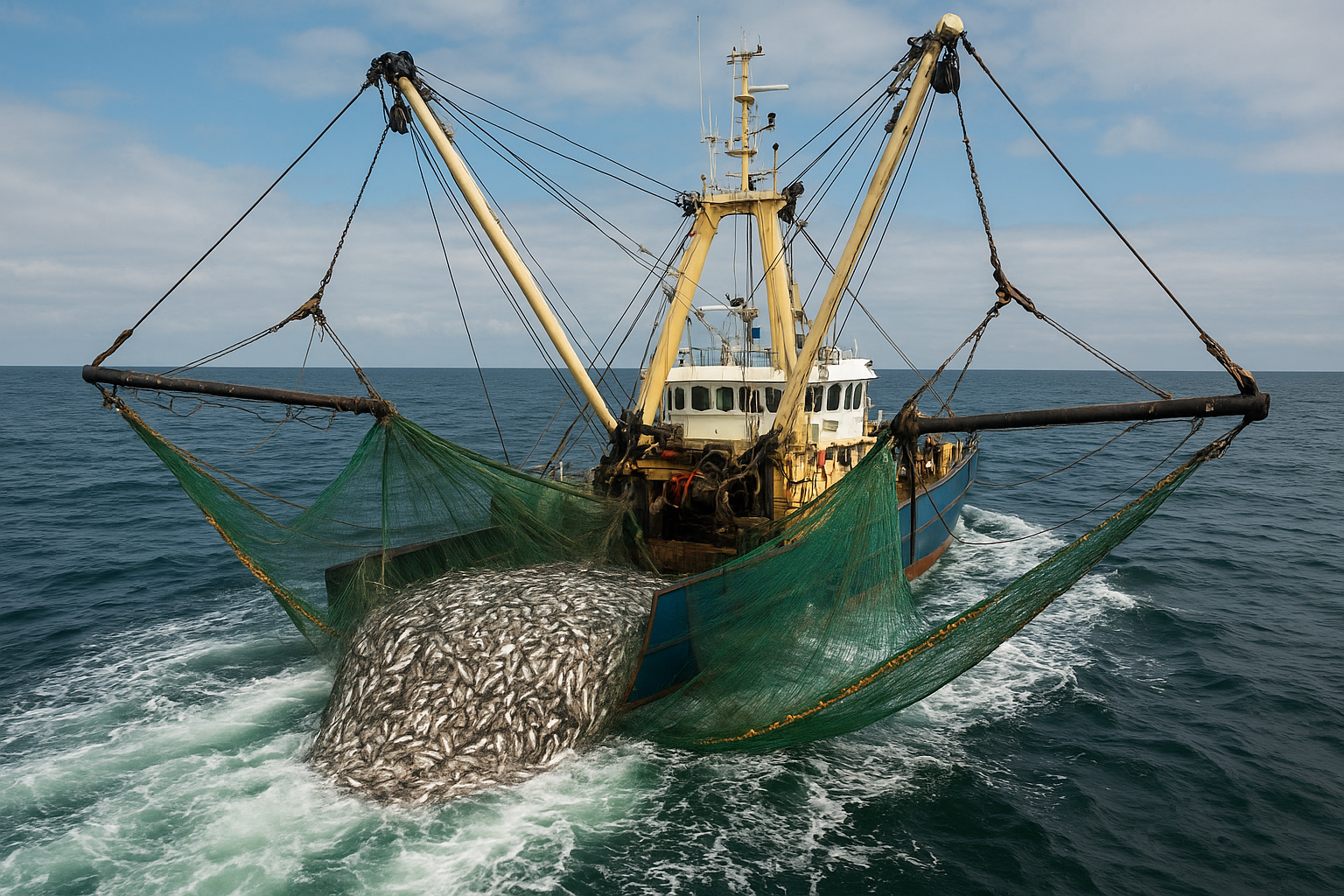
Dogger Bank is a large, flat sandbank area in the North Sea located in the exclusive economic zone (EEZ) of the United Kingdom, the Netherlands and Germany. Ecologically, it is one of the most important habitats in the North Sea with a high level of biodiversity, especially for bottom-dwelling organisms, fish and seabirds. In terms of fishing, it has been one of the most important fishing grounds for centuries, which is why its protection now plays a central role in marine conservation.
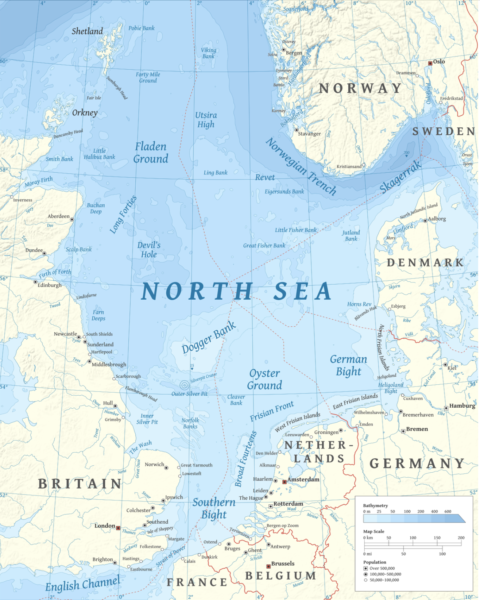
It is therefore remarkable that a marine protected area (MPA) covering all three countries with a total area of ≈ 18,690 km² (UK 12,331 + NL 4,735 + DE 1,624), is established, in which fishing that is harmful to biodiversity, especially bottom fishing, is prohibited throughout the entire area. In the British sector, the protected area overlaps by about 80% with the country’s largest offshore wind farm. A law enacted on 13 June 2022 already prohibits bottom-contact fishing in the entire wind farm area. This means that a further 20% (= 310 km² ) of the wind farm could be added to the Dogger Bank MPAs of the three countries, resulting in a total area of approximately 19,100 km², a zero-bottom trawling zone, which corresponds to around two-thirds of the land area of Belgium.
This total area of the Dogger Bank of around 19,100 km² has now been protected from bottom trawling since 18 November 2025, after Germany and the Netherlands also designated their protected areas, as explained in the following press release from the Federal Agency for Nature Conservation in Germany:
_______________________-
“Largest sandbank in the North Sea is to be better protected against the effects of mobile bottom fishing.
The European Commission has adopted new fisheries management measures to protect endangered species and habitats in the protected areas of the German and Dutch exclusive economic zones in the North Sea. This will strengthen the protection of the largest sandbank in the North Sea in the ‘Dogger Bank’ marine protected area against the consequences of mobile bottom fishing, such as bottom trawling. The regulations are based on joint proposals by the Federal Ministry for the Environment (BMUKN) and the Federal Ministry of Agriculture (BMLEH), which Germany and the Netherlands have coordinated with the EU neighbouring states of the North Sea. Under EU law, member states are obliged to strengthen marine protection.
Federal Minister for the Environment, Climate Protection, Nature Conservation and Nuclear Safety, Carsten Schneider: “The Dogger Bank is the heart of the North Sea – a unique habitat for fish, whales, dolphins and seals. Protecting it means keeping our seas alive. The North Sea and Baltic Sea are under enormous pressure, so we must act to allow them to recover. By exempting parts of Dogger Bank from mobile bottom fishing, we are giving endangered species a real chance and strengthening the North Sea as a whole. Only if we use our seas wisely can we continue to count on them in the future: for healthy ecosystems and fish stocks.”
Federal Minister for Agriculture, Food and Rural Affairs, Alois Rainer: “Protecting the sea means safeguarding the future of our fisheries. The measures that have now been adopted strike a fair balance between effective marine conservation and the legitimate interests of fishing businesses. Only a healthy, stable ecosystem in the North Sea will ensure good catches tomorrow – and thus the livelihoods of many families in our coastal regions. Our fisheries are more than just an industry – they are part of our homeland. They shape life on the coast and connect generations. This must be preserved – in harmony with nature and for the sake of future generations.”
The EU Commission’s delegated act includes – in addition to the restrictions already in force – further fisheries management measures in the Dogger Bank Natura 2000 marine protected area. The act was published in the EU Official Journal on 29 October 2025 and will enter into force on 18 November 2025. Fishing with mobile bottom-contacting gear, such as bottom trawls or seines, will therefore no longer be possible in about half of the existing protected area throughout the year. The largest sandbank in the North Sea also extends to the territories of neighbouring states. In order to create joint measures for the German and Dutch parts, the measures were therefore developed together with the Netherlands. The European Commission’s regulation is based on a joint recommendation by the EU North Sea Regional Fisheries Group, known as the Scheveningen Group. The measures make an important contribution to preserving biodiversity in the marine protected areas of the Natura 2000 network and to implementing the Marine Strategy Framework Directive, which Germany is obliged to implement under European law.
Background:
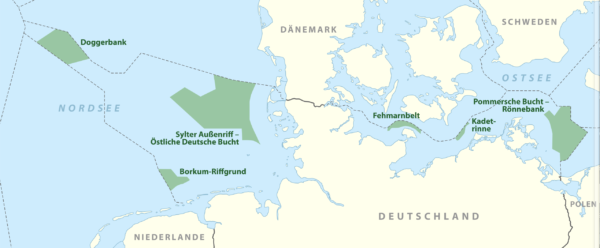
Delegated Regulation (EU) 2025/2191 of the European Commission extends the conservation measures that came into force in 2023 in the marine protected areas of the German exclusive economic zone (EEZ) in the North Sea. With an area of around 18,000 square kilometres (km2), the Dogger Bank is the largest sandbank in the entire North Sea. It stretches over 320 kilometres (km) from the continental shelf of Great Britain to Dutch, German and Danish marine areas. The Dogger Bank nature reserve is located in the German part of this unique sandbank. It is located around 250 km from the mainland in the north-western part of the North Sea EEZ and is part of the European Natura 2000 network of protected areas. The EEZ is the area beyond the coastal sea, i.e. the sea area at a distance of twelve to a maximum of 200 nautical miles from the coastline, in which the coastal state can exercise sovereign rights and jurisdiction to a limited extent. Responsibility for the protected areas in the EEZ lies with the federal government, while the areas in the territorial sea (up to twelve nautical miles) fall under the jurisdiction of the federal states. The EU’s nature conservation directives (the Fauna-Flora-Habitat Directive and the Birds Directive) specify species and habitats for which protected areas must be designated in order to achieve an ecologically coherent network of protected areas (NATURA 2000). In accordance with Article 6 of the EU Habitats Directive and Article 4 of the EU Birds Directive, Germany is obliged to establish measures for the conservation or restoration of the so-called ‘favourable conservation status’ of these species and habitats. There are also obligations under Article 13(4) of the EU Marine Strategy Framework Directive. Measures for commercial fishing are laid down in EU law under the Regulation on the Common Fisheries Policy. To this end, measures to regulate fishing must be agreed with all EU Member States with an economic interest. Once agreement has been reached with all the countries concerned, a ‘joint recommendation’ can then be submitted to the relevant regional group of the European Commission, which then makes it binding by means of an EU regulation.”